
FULL-SERVICE MEDICAL BILLING
Medical Billing That Keeps Revenue Moving
Billing Horizon combines specialty-specific billing teams, AI-assisted workflow intelligence, payer knowledge, and disciplined follow-up to manage the work between patient care and reimbursement. Every claim stays visible from charge capture through payment, denial resolution, and accounts receivable recovery.
✓ 60+ specialties supported ✓ Works with your existing EHR ✓ Human review at critical decisions
Claim Control Center
Documentation and edit checks complete
Items prioritized by financial and filing risk
01
Specialty context before claim creation
02
Payer logic before submission
03
Exception ownership after adjudication
04
Performance visibility throughout the cycle
THE OPERATING QUESTION
Where Is Revenue Losing Momentum?
A claim may be delayed long before a payer denies it. Missing eligibility details, incomplete documentation, authorization gaps, code selection, claim edits, and unworked payer responses all create friction at different points. Effective medical billing connects those points so the team can correct the cause, not simply move the task.
PATIENT ACCESS
Coverage Confirmed
Eligibility, benefits, demographics, referrals, and authorization requirements are checked before they become claim defects.
CLINICAL RECORD
Service Supported
Documentation is reviewed against the service, diagnosis, units, time, modifiers, and payer requirements involved.
CLAIM PRODUCTION
Edits Resolved
Claims move through specialty, payer, and clearinghouse checks to reduce the risk of missed timely filing deadlines.
ADJUDICATION
Response Interpreted
Payments, underpayments, rejections, and denials are routed to the right owner with the next action defined.
ONE CONNECTED BILLING OPERATION
Every Workstream Has an Owner. Every Outcome Has a Trail.
Billing Horizon manages the daily work that determines whether a service becomes a clean claim, a correctly posted payment, or an aging balance that receives timely follow-up.
01
Eligibility & Benefits
Coverage status, plan details, patient responsibility, referrals, and authorization requirements are verified and documented.
02
Charge & Claim Review
Patient, provider, diagnosis, procedure, modifier, unit, place-of-service, and payer data are checked before submission.
03
Claim Submission
Validated claims are transmitted, clearinghouse responses are monitored, and rejections are corrected without losing filing time.
04
Payment Posting
ERA and EOB activity is posted with contractual adjustments, patient balances, denials, and variances classified accurately.
05
Denial Resolution
Denials are worked by category, payer, root cause, appeal requirement, and deadline instead of sitting in a general queue.
06
A/R Follow-Up
Outstanding balances are segmented by age, value, payer, claim status, and recoverability so effort follows financial priority.
AI-ASSISTED WORKFLOW INTELLIGENCE
Automation Should Find the Work. People Should Make the Decision.
Billing Horizon uses AI-assisted analysis to surface anomalies, organize work queues, identify recurring patterns, and highlight claims that may need attention. Experienced billing and coding professionals remain responsible for reviewing the clinical, payer, and financial context before action is taken.
Operational guardrail
AI-generated signals support review. They do not replace documentation, payer policy, coding guidance, or professional judgment.
review
source
SPECIALTY-SPECIFIC DEDICATED TEAMS
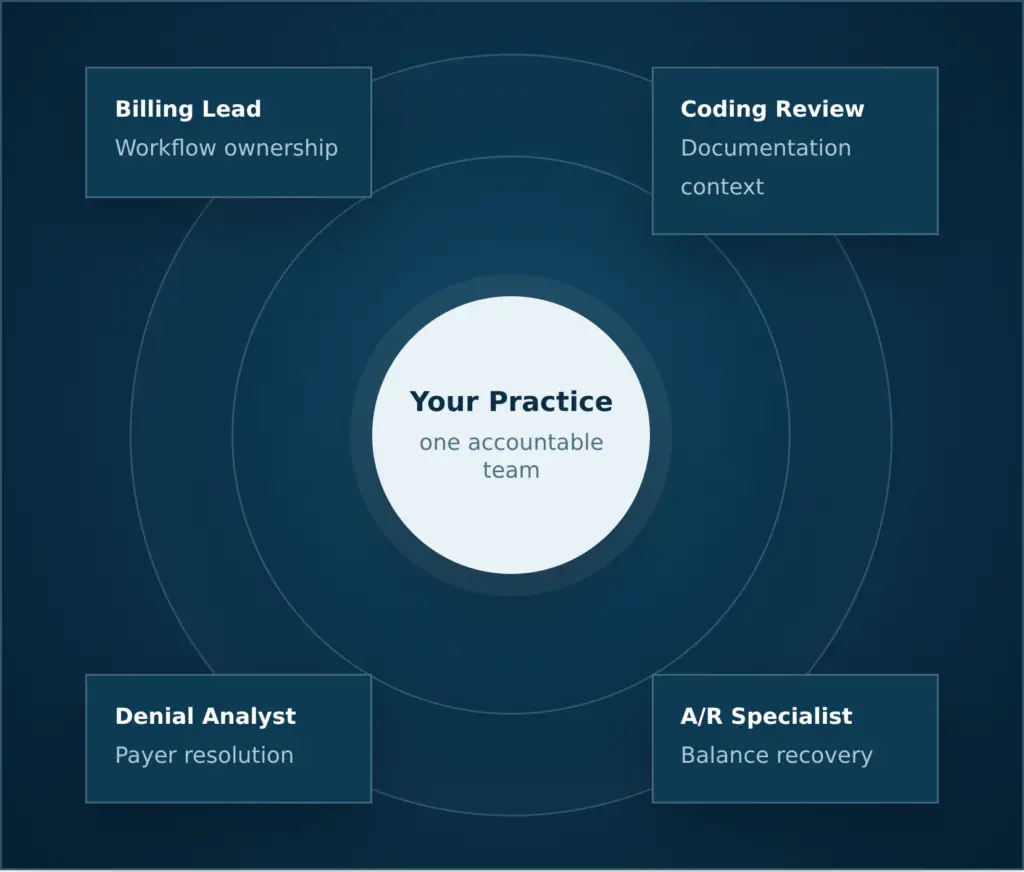
Your Billing Team Should Understand How Your Practice Delivers Care
A behavioral health group, oncology center, urgent care network, surgical practice, and therapy clinic do not create the same documentation, code combinations, authorization patterns, or payer questions. We align team knowledge with the specialty, service mix, location structure, and payer profile of the practice.
Specialty-specific coding and documentation familiarity
Defined roles for billing, coding, denials, and A/R
Escalation paths for clinical or payer clarification
Cross-training that protects continuity during staffing changes
Tell us about your specialty
CONTINUOUS COMPLIANCE MONITORING
Rules Change While Claims Are Still Moving
Compliance is not a final claim edit. It influences documentation, code selection, data access, authorization, submission, and follow-up. Billing Horizon monitors changes that affect active workflows and translates relevant updates into review criteria, team guidance, and process controls.
2026 OPERATING CONTEXT
What billing teams must keep in view
CMS
Medicare Payment Policy
The CY 2026 Physician Fee Schedule includes policy and payment changes effective January 1, 2026. Billing controls must reflect the applicable year, locality, service, and provider context.
Monitor
AMA / CMS
Code Set Governance
CPT, ICD-10-CM, and HCPCS Level II updates require coordinated changes across documentation prompts, charge capture, claim edits, and staff guidance.
Translate
HHS
HIPAA Safeguards
Access, use, transmission, and storage of ePHI require administrative, physical, and technical safeguards appropriate to the billing relationship.
Control
PAYERS
Coverage & Authorization
Commercial, Medicare Advantage, Medicaid, and federal program rules can differ by plan, service, geography, and effective date.
Apply
Operational references: CMS CY 2026 PFS Final Rule, HHS HIPAA Security Rule summary, and CMS Interoperability and Prior Authorization Final Rule. This page describes operational support and is not legal advice.
EMR / EHR TECHNOLOGY INTEGRATION
Keep the System Your Team Knows. Improve What Happens Around It.
A billing transition should not force clinicians to rebuild how they document care. Our implementation team maps the data, access, work queues, reports, and handoffs already present in your environment, then defines the controls needed to support billing operations.
Data access
Encounters, charges, documents, eligibility, claim status, ERA, and reports
Workflow mapping
Owners, queues, dependencies, escalation points, and turnaround expectations
Reconciliation
Source-to-claim and claim-to-payment checks that expose missing activity
EMR / EHR
Clinical and encounter data
Revenue Operations
Claims, exceptions, follow-up
A CONTROLLED TRANSITION
Changing Billing Partners Should Not Interrupt Cash Flow
The transition plan is built around continuity. Open claims, aging balances, payer enrollments, system access, reporting requirements, and unresolved issues are inventoried before operational ownership changes.
01
DISCOVER
Baseline the Operation
Review payer mix, specialty, systems, staffing, volumes, aging, denials, and current performance definitions.
02
MAP
Define the Handoffs
Document access, queues, responsibilities, escalation paths, files, interfaces, and reporting cadence.
03
VALIDATE
Test Before Go-Live
Confirm data, claims, edits, payer setup, posting logic, and reports with parallel checks where appropriate.
04
STABILIZE
Protect the First Cycles
Monitor submission, rejections, deposits, backlog, and communication closely while ownership settles.
You keep visibility throughout the transition. The plan identifies what moves, who validates it, what remains open, and how progress will be reported.
TRANSPARENCY & REPORTING
A Report Is Useful Only When It Changes the Next Decision
Financial totals explain what happened. Operational reporting should also explain why it happened, where work is accumulating, which payer or service line is driving the variance, and what action is underway.
Definitions agreed before performance is compared
Trend views by payer, provider, location, specialty, and service
Denial categories connected to source workflow
Open issues paired with owners and next actions
Revenue Performance
EFFICIENT REVENUE OPTIMIZATION
Improve the System, Not Just the Month
Revenue optimization is a repeatable operating cycle. The team measures performance, isolates the source of friction, changes the relevant workflow, and checks whether the change improved the result.
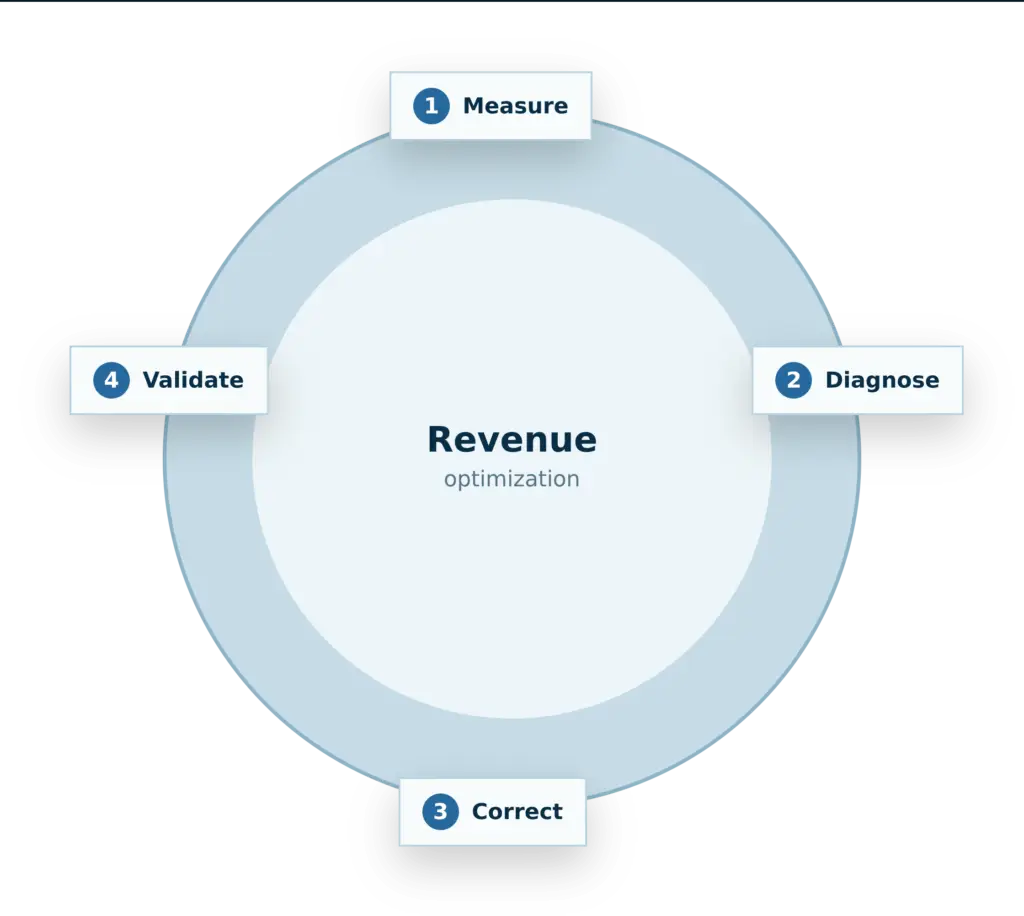
Measure
Establish clean claim, rejection, denial, payment, aging, and productivity baselines with consistent definitions.
Diagnose
Segment the variance until the underlying payer, specialty, provider, location, or workflow pattern becomes visible.
Correct
Update the responsible edit, handoff, training, documentation request, payer action, or work queue.
Validate
Track the affected claims and confirm that the correction changed the outcome without creating another defect.
QUESTIONS DECISION-MAKERS ASK
The Questions Behind Choosing a Medical Billing Partner
The right discussion is not whether tasks can be moved. It is whether control, accountability, knowledge, and visibility improve after they move.
We baseline open work, confirm access and payer setup, map every handoff, validate output, and monitor the first billing cycles closely. Transition ownership is documented rather than assumed.
Reporting combines financial outcomes with operational detail, including claim status, denial causes, aging movement, work queues, open issues, owners, and next actions.
Our integration approach begins with your existing environment. Access, data flow, queues, interfaces, files, reconciliation points, and reporting are mapped before the operating model is finalized.
AI-assisted tools help identify patterns, anomalies, and priority work. Billing and coding professionals review the documentation, payer policy, coding logic, and financial context before consequential action.
We agree on metric definitions, establish a baseline, segment trends by relevant operating variables, and connect each material variance to an action plan. Improvement is evaluated over comparable periods, not inferred from a single number.
CLIENT PERSPECTIVE
The Difference Shows Up in the Daily Work
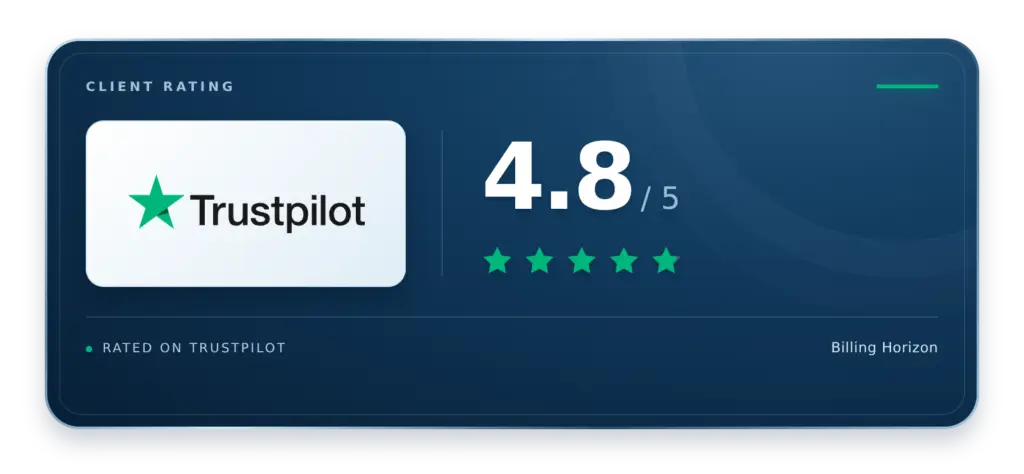
Practice leaders need to see more than a monthly collection figure. Clear claim ownership, timely follow-up, and useful answers to billing questions shape the everyday experience.


START WITH THE OPERATION YOU HAVE
Let’s Identify Where Your Billing Workflow Needs More Control
Tell us about your specialty, payer mix, current billing model, EHR, and the performance concern you want to solve. We will use that context to structure the first conversation around your actual revenue cycle.
✓ No generic product presentation
✓ Your current workflow stays central
✓ Clear next steps after the discussion
REQUEST A BILLING ASSESSMENT
Tell us about your practice
No obligation. No pressure. Just a practical conversation about your revenue cycle.