
⸻ AI-ENABLED MEDICAL BILLING OPERATIONS
The Revenue Cycle, Managed From the Inside Out
Billing Horizon brings together experienced billing professionals and AI-enabled technology to create a more controlled, measurable revenue cycle. We operate as an extension of your practice, handling the billing processes, payer requirements, coding workflows, denials, and outstanding accounts that directly affect reimbursement.
✓ No upfront commitment ✓ Practice-specific review ✓ Human-led expertise
Operational overview
ONE CONNECTED OPERATION
⸻⸻⸻⸻⸻⸻⸻⸻⸻⸻
PEOPLE TECHNOLOGY PAYER KNOWLEDGE FOLLOW THROUGH
Built Around Your Revenue Cycle
We Take Ownership of the Work Behind Every Claim
A healthy revenue cycle depends on how well its individual processes work together. Billing Horizon connects the people, technology, payer knowledge, and follow through required to move claims from patient encounter to reimbursement with greater control and fewer breakdowns between each stage.
People Who Understand the Workflow
Our billing specialists understand how documentation, coding, claims, payments, denials, and A/R connect. That operational context helps us address the cause of a billing issue rather than simply correcting the symptom.
AI Where It Improves the Process
We use AI-enabled technology to support high-volume billing workflows, identify exceptions, surface potential issues, and reduce repetitive administrative work. Human specialists remain responsible for decisions that require billing judgment, payer interpretation, or practice-specific context.
Payer Rules Applied at the Claim Level
Medicare, Medicaid, and commercial payers do not always apply the same coverage, authorization, documentation, or claim requirements. We incorporate payer specific rules into day-to-day billing workflows so claims are worked according to the requirements that actually govern reimbursement.
Continuous Attention to A/R and Denials
A submitted claim is not the finish line. We monitor unpaid claims, denials, underpayments, and aging accounts to determine what is holding reimbursement back and what action is required to move the account forward.
FULL SCOPE REVENUE CYCLE SERVICES
Every Part of the Billing Operation, Connected.
From front end revenue integrity to final reimbursement, Billing Horizon brings the essential revenue cycle functions together under one coordinated operation. Each service is supported by specialty-specific workflows, payer knowledge, experienced billing professionals, and technology designed to improve how work moves through the cycle.
Medical Billing Services
End-to-end billing management covering charge entry, claim submission, payment posting, denial follow-up, A/R management, and the payer-specific requirements that influence reimbursement.
Medical Coding Services
Accurate CPT, HCPCS, and ICD-10-CM coding supported by documentation review and specialty specific coding knowledge to help claims reflect the services actually performed and reduce preventable coding-related issues.
Medical Credentialing Services
Provider enrollment and credentialing support across Medicare, Medicaid, and commercial payers, helping providers maintain accurate enrollment records and stay positioned to bill participating payers.
Revenue Cycle Management
A broader operational view of the revenue cycle, connecting front end processes, claims, payments, denials, A/R, and performance reporting to identify where revenue is being delayed or lost.
AI Technology Inside the Revenue Cycle
Technology Should Make the Billing Operation Smarter, Not Less Human
Billing Horizon uses AI where it can improve speed, consistency, and visibility across high-volume billing workflows. Our technology helps organize information, identify exceptions, recognize patterns, and bring potential issues to the attention of billing specialists. The objective is not to replace billing judgment. It is to give our people better information and more time to focus on the work that requires experience.
Where AI Adds Operational Value
AI can help identify claims that need attention before they become larger A/R problems, recognize recurring denial patterns, flag workflow exceptions, and reduce repetitive administrative work. Our specialists review the findings, apply payer and specialty knowledge, and determine the appropriate action.
Automation handles repetition. Our billing specialists handle the decisions.
Analyzing workflow
Exception detection in progress
SEE TECHNOLOGY IN PRACTICE
See Where AI Can Strengthen Your Billing Workflow
Tell us a little about yourself and we'll show you how Billing Horizon combines AI technology with experienced billing professionals to improve visibility, reduce repetitive work, and support a more controlled revenue cycle.
01
Review your current workflow
02
Identify areas where AI adds value
03
See how specialists stay in control
Schedule a walkthrough
Takes less than a minute
No upfront commitment. No obligation. Just a conversation about your billing operation.
Billing Horizon by the Numbers
A Billing Operation Measured at Every Stage
Revenue cycle performance becomes easier to manage when the right activity is visible. We track the operational metrics that show how billing work is progressing, where issues are developing, and where additional attention is required.
PAYER KNOWLEDGE THAT DRIVES BETTER BILLING DECISIONS
Every Payer Has Rules. We Build Them Into the Workflow.
A claim can be correctly coded and still fail because the payer expects something different. Medicare, Medicaid, and commercial health plans each have their own coverage policies, authorization requirements, claim edits, documentation expectations, and reimbursement rules. Those requirements can also vary by plan, service, specialty, and provider participation status.
Billing Horizon incorporates payer-specific requirements into day to day billing operations rather than treating them as an afterthought. Our specialists review payer responses, identify the reason behind rejections and denials, and determine the appropriate next step based on the applicable policy, claim history, and documentation.

Beyond Clean Claim Submission
Eligibility is not the same as coverage. Authorization is not the same as payment. And a clean claim is not necessarily a payable claim. Effective billing requires understanding what the payer expects before, during, and after claim submission.
We don't just track what a payer paid. We examine why it paid, why it didn't, and what the billing operation should do next.
MEDICARE
MEDICAID
COMMERCIAL PLANS
REGIONAL PAYERS
MANAGED CARE
YOUR PAYER MIX MATTERS
Let's Look at Where Your Claims Are Getting Stuck
Share your payer mix with Billing Horizon and discuss the requirements, rejection patterns, denial trends, and reimbursement challenges affecting your revenue cycle.
BUILT AROUND HOW YOU PRACTICE
Different Specialties. Different Billing Challenges.
Billing requirements change with the services a practice provides, the way care is documented, the codes used, and the payer policies that apply. Billing Horizon supports more than 60 specialties, with workflows built around the coding, authorization, documentation, claim edits, and reimbursement requirements that shape each specialty's revenue cycle.
SPECIALTY-ALIGNED WORKFLOWS
60+ Specialties Supported
Billing Horizon supports more than 60 medical specialties, from primary care and surgical practices to rehabilitation, behavioral health, oncology, urgent care, and diagnostic services. Our teams adapt billing workflows to each specialty’s documentation, coding, authorization, and payer requirements so the work reflects how that practice delivers care.
SPECIALTY-ALIGNED WORKFLOWS
Behavioral Health
Behavioral health billing requires careful attention to psychotherapy and psychiatric service codes, time based documentation, place of service, telehealth requirements, modifier usage, authorization limits, and payer specific coverage policies. Our workflows account for these variables when claims are prepared, reviewed, and followed through adjudication.
SPECIALTY-ALIGNED WORKFLOWS
Oncology
Oncology revenue cycles involve complex combinations of E/M services, chemotherapy and immunotherapy administration, drug and biological HCPCS codes, J codes, units, NDC information, diagnosis coding, and medical necessity requirements. Billing workflows must also account for payer policies surrounding treatment authorization, infusion services, and drug reimbursement.
SPECIALTY-ALIGNED WORKFLOWS
Urgent Care
Urgent care billing depends heavily on accurate E/M leveling, procedure coding, documentation, modifier application, place of service, and timely eligibility verification. High patient volume also makes front end accuracy critical, particularly when commercial and government payer requirements differ across visits, procedures, and ancillary services.
LET'S TALK ABOUT YOUR SPECIALTY
Your Billing Workflow Should Reflect the Way You Practice
Tell us your specialty and a few contact details. We'll use the conversation to understand the services you bill, the payer requirements you encounter, and the areas of your revenue cycle that need the most attention.
No upfront commitment. No obligation. Just a conversation about your billing operation.
YOUR TECHNOLOGY, OUR WORKFLOW.
Your Billing Workflow Should Fit Your Practice, Not the Other Way Around
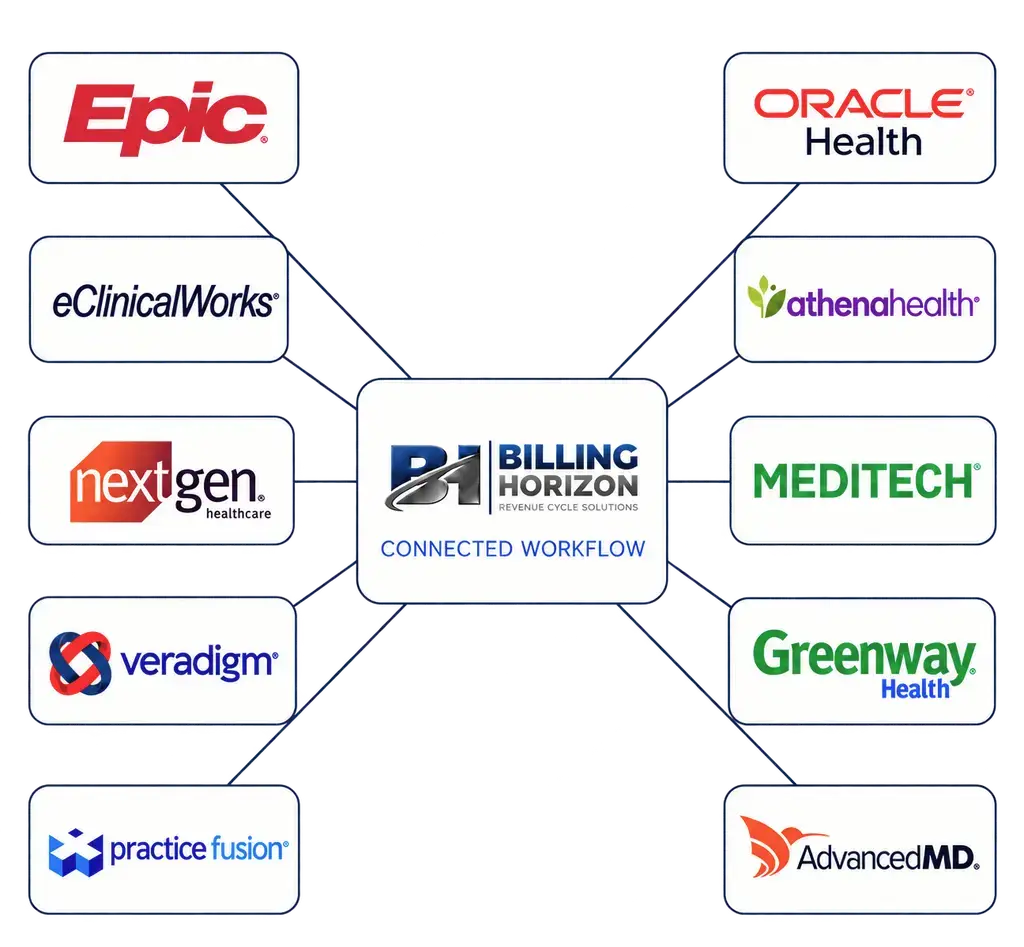
Billing Horizon works within the technology environment your practice already uses, supporting billing workflows across platforms such as eClinicalWorks, Epic, NextGen Healthcare, athenahealth, and other EMR and EHR systems. Our teams understand how clinical documentation, charge capture, demographics, insurance information, coding, and claim data move from the patient encounter into the revenue cycle.
The Data Entering the Billing Workflow Matters
Incomplete demographics, missing insurance details, charge capture issues, and documentation gaps can create billing problems before a claim reaches the payer. Our specialists identify these exceptions within the workflow and coordinate the necessary corrections before they create downstream rework.
Keep the EMR your practice knows. Let Billing Horizon adapt the billing operation around it.
REGULATORY & COMPLIANCE STANDARDS
Billing Rules Change. Our Compliance Process Has to Keep Up.
Medical billing operates within a regulatory environment that changes with new federal requirements, CMS guidance, payer policies, and enforcement activity. Billing Horizon maintains an ongoing review process to monitor relevant regulatory developments and assess how changes may affect our billing workflows, documentation practices, payer processes, and handling of protected health information.
Compliance Is an Ongoing Review, Not a One-Time Checklist
Our compliance process considers requirements under HIPAA, CMS billing and coding guidance, the No Surprises Act, and applicable payer and regulatory policies. When relevant requirements change, we review the operational impact, update internal procedures where necessary, and communicate workflow changes to the teams responsible for implementation.

HIPAA
We maintain processes for protecting PHI and ePHI throughout billing operations, including appropriate access, handling, transmission, and administrative safeguards. HHS OCR continues to enforce HIPAA requirements and emphasize risk analysis and appropriate security safeguards, making compliance an ongoing operational responsibility rather than a static certification.

No Surprises Act
Billing workflows account for applicable surprise billing protections, Good Faith Estimate requirements, patient-provider dispute resolution, and related payer and provider obligations. CMS also finalized updated Federal IDR operational standards in 2026, reinforcing the need to monitor changes affecting payment disputes and the provider-payer process.

CMS & Payer Requirements
Medicare requirements, coding guidance, coverage policies, claim edits, authorization rules, and commercial payer policies can directly affect whether a claim is accepted and reimbursed. Our billing teams incorporate applicable requirements into claim review and follow-up rather than treating regulatory knowledge as a separate administrative function.
Our Internal Review Process
We monitor the rules that govern the work, assess what changes mean for the operation, and keep applicable requirements connected to the billing workflow.
Monitor
Assess
Communicate
Update
Regulatory monitoring does not end with reading an update. When a relevant rule, guidance document, or payer requirement changes, we assess what it means operationally, determine which workflows may be affected, communicate applicable changes to the responsible teams, and update internal procedures where necessary.
REVENUE CYCLE VISIBILITY
Know What Is Happening With Your Revenue. And Why.
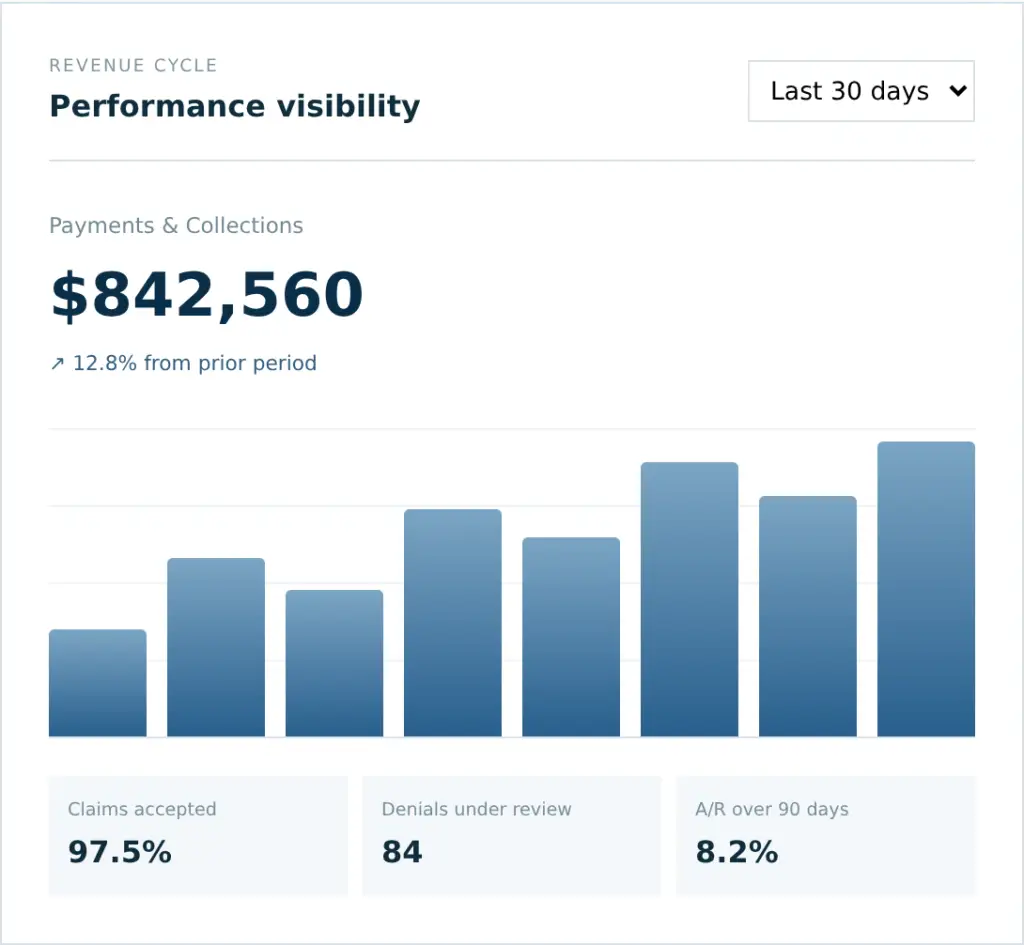
Billing Horizon gives providers visibility into the activity behind their financial results. Instead of looking only at collections, you can see what is happening across claims, denials, A/R, payments, and payer activity.
Track submitted claims, payer rejections, acceptance patterns, and issues that prevent claims from moving cleanly through adjudication.
Identify denial volume, recurring denial reasons, payer patterns, and the status of corrective action and appeals.
Monitor outstanding balances by aging category, payer, and account so unresolved receivables receive appropriate follow-up before they become harder to collect.
Review payment activity, collection trends, contractual adjustments, and reimbursement patterns to understand how billed revenue is converting into cash.
The number is only the starting point. The real value comes from understanding what is driving it and what needs to happen next.
WHAT OUR CLIENTS SAY
A Billing Partner Should Make the Revenue Cycle Easier to Manage



FROM CURRENT WORKFLOW TO BETTER CONTROL
Changing Billing Companies Should Not Disrupt Your Revenue Cycle
Switching billing partners involves more than transferring claims and account information. Billing Horizon approaches the transition as an operational handoff, with attention to your existing workflows, EMR environment, payer mix, open A/R, active claims, and responsibilities across the revenue cycle.
01
Understand Your Current Operation
We review your existing billing workflow, specialty mix, payer environment, EMR setup, A/R aging, denial inventory, coding processes, charge capture, and areas requiring immediate attention.
02
Prepare the Billing Workflow
Before ongoing billing begins, we establish system access, communication protocols, reporting requirements, workflow responsibilities, payer information, and transition priorities. This gives both teams a clear operating framework from the start.
03
Transition Active Revenue Cycle Work
Claims, outstanding A/R, payment posting, denials, charge capture, and daily billing activity move into the agreed workflow with continuity of operations as a priority. Open accounts do not simply disappear during the transition.
04
Stabilize, Measure & Improve
Once the workflow is established, we monitor claim activity, denials, A/R, collections, and other operating indicators. Recurring issues are identified and addressed as the billing operation becomes more stable.
A MORE CONTROLLED REVENUE CYCLE STARTS HERE
Let's Build a More Controlled Revenue Cycle
Let's start with a conversation about your current billing workflow, where revenue is getting held up, and what a controlled transition could look like for your practice.
No obligation. No pressure. Just a practical conversation about your current billing operation.
PEOPLE
TECHNOLOGY
PAYER KNOWLEDGE
FOLLOW THROUGH